|
What is Park Flight?
Park Flight is a partnership between the National Park Service, National Park Foundation, and National Fish & Wildlife Foundation/USAID. The Park Flight Migratory Bird Program works to protect shared migratory bird species and their habitats in both U.S. and Latin American national parks. Park Flight has funded bird conservation and education projects in 14 U.S. national parks, including Bandelier National Monument.
Field Trips
Our local Park Flight Migratory Bird Program takes place at Bandelier National Monument. PEEC has funding for sixth-grade classes from Los Alamos and other area schools to take field trips to Bandelier to learn about research on migratory birds. Transportation costs will be covered, along with a pre-field trip classroom session to introduce students to migratory birds and the methods scientists use to study them. Bandelier wildlife biologist Stephen Fettig leads the project with help from two international interns from Central or South America.
Field trips are offered in September. Please contact our educator if your classroom would like to participate.
Student Objectives
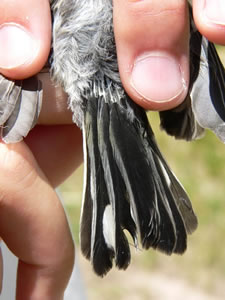
The Park Flight objectives are two-fold. The bird-banding component helps us better understand scientific observation of migratory birds in Northern New Mexico. The student-education component teaches young people about animal-habitat relationships, geography of North and Central America, and problem solving skills through field trips and classroom presentations.
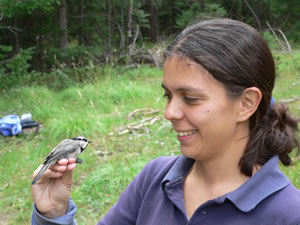
Besides seeing birds up close, kids will see how the birds are caught in mist nets, take an "I Spy" walk in the woods, and do a plant survey. Both the classroom visit and field trip are geared to state science standards.
Bird Banding
For adults and families, the bird-banding process may be seen up close on some Saturdays in August and September, weather permitting. Please check our Calendar or contact us for specific dates and times. Visitors will observe researchers studying the changing populations of migratory birds along the edge of the Cerro Grande at a site just below Camp May, 2.7 miles above the intersection of the Camp May Road and the new West Road. The regenerating aspen can be a magnet for warblers of several species. Look for the large dirt parking area on the right after the second silver guardrail as you drive up the Camp May Road, then walk the 0.1 mile along a two-track road to the main event. The project is another part of the Park Flight program, also led by Stephen Fettig and the Latin American interns.
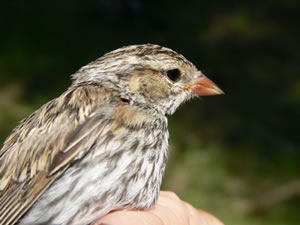
Both programs provide a rare chance to see Mountain Chickadees, Hermit Thrushes, Ruby-Crowned Kinglets, and other migratory birds up close. The high point for most attendees is the moment when the banded bird is released, often by one of the observers, to continue its journey south from the Jemez Mountains.
|