
Events
See all: Calendar
Los Luceros Day Camp (WAITLIST ONLY)
Mon, June 1Night Sky in June
Tue, June 2Walk-In Planetarium Show
Wed, June 3Nature at Night: Summer Series! Birds of Prey
Wed, June 3Happy Ramblers
Thu, June 4Rise & Hike
Fri, June 5Seeing!
Fri, June 5Pride Month Bird Walk
Sat, June 6Two Small Pieces of Glass: The Amazing Telescope
Sat, June 6Bird Walk at Los Luceros
Sun, June 7Pathfinders: PEECachu! - WAITLIST ONLY
Mon, June 8Dogs in Space
Tue, June 9Walk-In Planetarium Show
Wed, June 10Nature at Night: Summer Series! Robot Dog
Wed, June 10See all: Calendar
Party for PEEC
April 22, 2012
5:00 - 7:00 p.m.
|
The Party for PEEC menu for 2012 was selected and will be prepared by Felicia Orth. Purchase tickets at: Party for PEEC registration Menu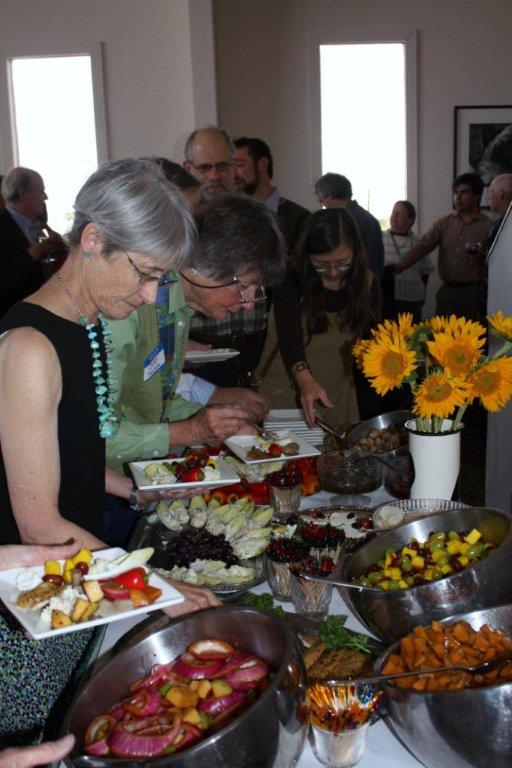
Appetizers
Bread
Entrees
Desserts
Founding Fathers and Original Foodies - the Inspiration for 2012 Party for PEECBy Felicia Orth For the Earth Day Dinner two years ago, we explored the foods of the Americas around 1300, enjoying turkey, trout, protein-rich sunflower cakes, corn, squash, beans and chile. Last year, we focused on the foods that had been brought to the Americas by the Spanish around 1500, in the "Columbian Exchange" of foodstuffs, in which livestock, wheat, olives, citrus fruit and many other items were brought to the New World. This year, we move forward to the 1700s and the great leap in the diversity of America's food culture that was driven by the Founding Fathers, including John Adams, Benjamin Franklin, Thomas Jefferson, and George Washington. Although the Founders were statesmen, politicians, lawyers and authors, they were first farmers, passionate about the land and convinced that small-scale farms were the building blocks of the new nation. Thomas Jefferson's plantation, Monticello, was 5000 acres of fields and gardens. Jefferson and his workers (enslaved and free) grew 170 varieties of fruit and 330 varieties of vegetables there. George Washington's plantation, Mount Vernon, also had extensive fruit orchards and vegetable gardens, along with numerous outbuildings such as a smokehouse, greenhouse, gristmill, and distillery. Washington was also a commercial fisherman; he once owned property along ten miles of the Potomac River. Travel and trade brought new experiences and unusual foodstuffs. As Thomas Jefferson traveled to London and Paris to negotiate trade agreements and serve as a diplomat, he was introduced to a broad variety of foods and beverages from all over the world, and enthusiastically shared these foods back in the United States. In the port of Philadelphia, the largest port in the colonies, ships arrived several times a week bringing exotic tropical fruits from the West Indies, spices from the Spice Islands, dried plums and cherries from Germany and Seville oranges from Spain. Curries were quite popular then, including chicken curry, which is on the PEEC menu this year. Benjamin Franklin tried to counter the negative opinions he heard in London about American food, and published a long treatise, "Homespun," on the virtues of American cooking, particularly with foods that were not favored in England. In England, corn was thought to be animal food, while the colonists had relied upon it for essential nutrition for several decades. In January 1766, while in London, Franklin wrote a rebuttal to a news correspondent who had disparaged corn: "Pray let me, an American, inform the gentleman, who seems ignorant of the matter, that Indian corn, take it for all in all, is one of the most agreeable and wholesome grains in the world; that its green leaves roasted are a delicacy beyond expression; that samp, hominy, succotash, and nokehock, made of it, are so many pleasing varieties; and that johny or hoecake, hot from the fire, is better than a Yorkshire muffin..." Hoecake with corn is on the Earth Day menu this year, and will be slightly sweetened with maple syrup, as was the custom by 1796. Franklin had many favorite foods besides corn, including apples, cranberries, pickles ("Squeamish stomachs cannot eat without pickles"), rhubarb and potatoes. Franklin often asked his wife Deborah to ship him barrels of apples and cranberries while he lived abroad. The pickled fruits on the menu will include cranberries and apple juice. Pigs were first brought to this country by Hernando de Soto in 1539; descendants of that herd still run wild in the South as "razorbacks." Pigs brought by Walter Raleigh to Jamestown in 1607 multiplied, as pigs do, and along with corn helped save the colonists from starvation, especially as the number of cattle dwindled at times. The colonists not only consumed a substantial amount of pork; they used it for trade. Cured hams were an early export from the colonies. Washington and Jefferson both had smokehouses to process large quantities of meat, mainly pork. The ham on the menu is uncured, and will be lightly glazed. The Pilgrims also exported a lot of cod, preserving the fish with salt. The fish was so critical to the survival of the colonists that it became a symbol of prosperity, its image appearing on coins, crests, tax stamps and the 1776 New Hampshire state seal. Codfish cakes are on the menu, although we will have fresh cod, not salt cod, as a matter of taste. Although the Pilgrims refused to eat most of the other seafood enjoyed by the Native Americans in the 1600s, by the late 1700s, the Founding Fathers often served crabs and oysters from Chesapeake Bay at their dinner parties. The Crab Imperial dish on the menu is old and has had many names, including "Browned Crab" in a 1777 cookbook. Many of the items on the menu are there because Thomas Jefferson was enthusiastic about them. His descriptions of several vegetables would lead one to conclude that each was his "favorite." Asparagus was one of his favorites, and he described the appetizer on the menu in a letter to his son-in-law. The raspberry vinegar recipe was mailed to him at his request by the former maitre d' at the President's House. Other vegetable favorites include the garden pea (he grew 19 different varieties), lettuce and fennel ("The fennel is beyond every other vegetable, delicious... no other vegetable equals it in flavor.") Jefferson was also very fond of pasta, so much so that he was credited with introducing it to the states. After Jefferson returned from Europe, he ordered macaroni to be delivered with his wine shipments from Marseilles. Baked macaroni with parmesan cheese was served at Monticello. The dish on the menu will have green chile added with a nod to the Land of Enchantment; the other nod to the state that joined the Founding Fathers' United States 100 years ago will be the addition of red chile to the pecans that Jefferson and Washington planted when they were called "Illinois nuts." Jefferson was also passionate about another dairy-rich item: ice cream. Monticello's grounds included an icehouse. Vanilla was his favorite flavor. The ice cream will be served with strawberries, which abounded at Monticello at a time when they were not so frequent in others' gardens, prepared as Jefferson prepared them for John and Abigail Adams, with cream, wine and sugar. Finally, the tea: the Great Red Hibiscus is a perennial flower which arrived in the United States when President Washington ordered the plant for Mount Vernon. Join us for dinner, and reflect on the revolutionaries and farmers who had such a strong influence on the food we eat today, and the hospitality we share with one another. Note: The fish, meat, vegetables and fruit will come from Los Alamos Co-op Market. Sources: "The Founding Foodies. How Washington, Jefferson and Franklin Revolutionized American Cuisine," by Dave DeWitt, Sourcebooks, 2010. (Primary source, and source of most of the recipes.) "Founding Gardeners. The Revolutionary Generation, Nature and the Shaping of the American Nation," by Andrea Wulf, Knopf, 2011. |